Guide
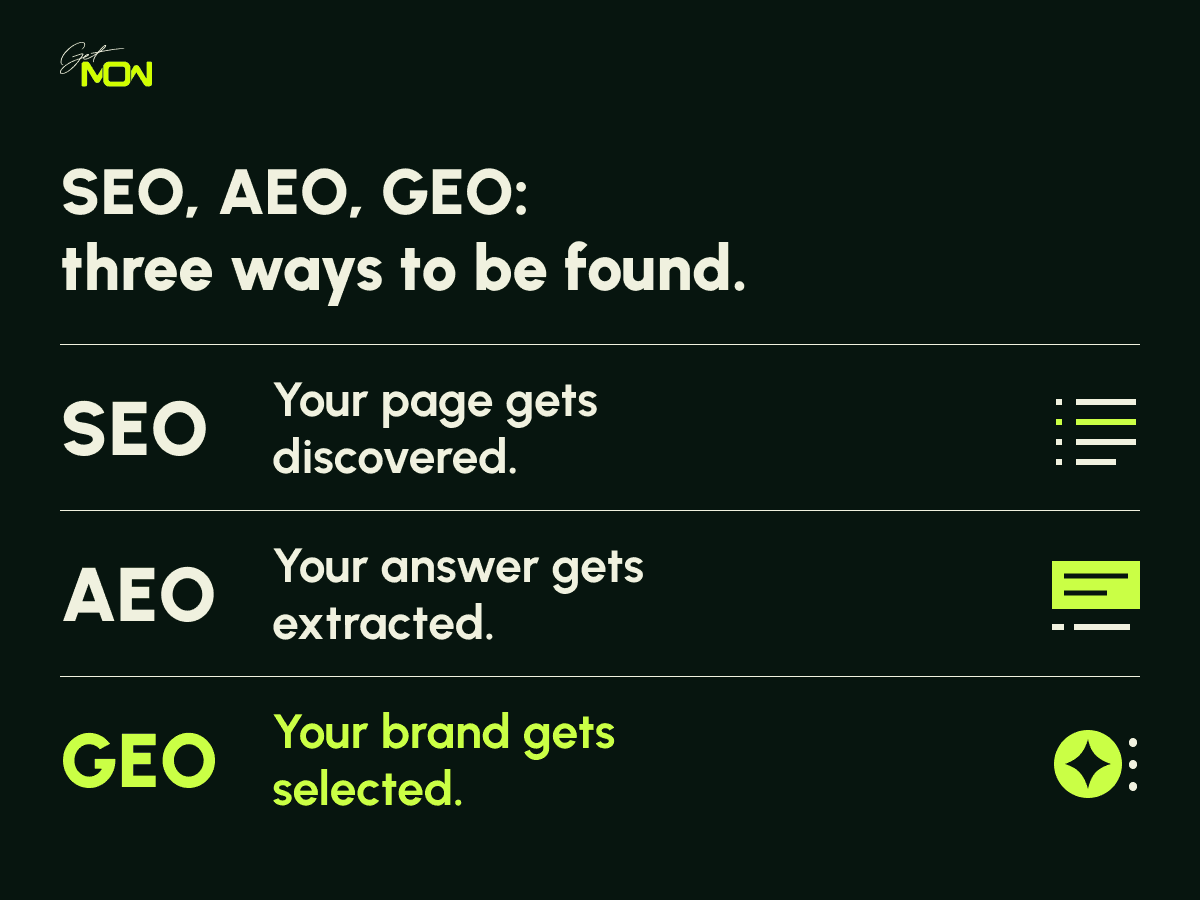
Discovered by SEO.
Extracted by AEO.
Selected by GEO.
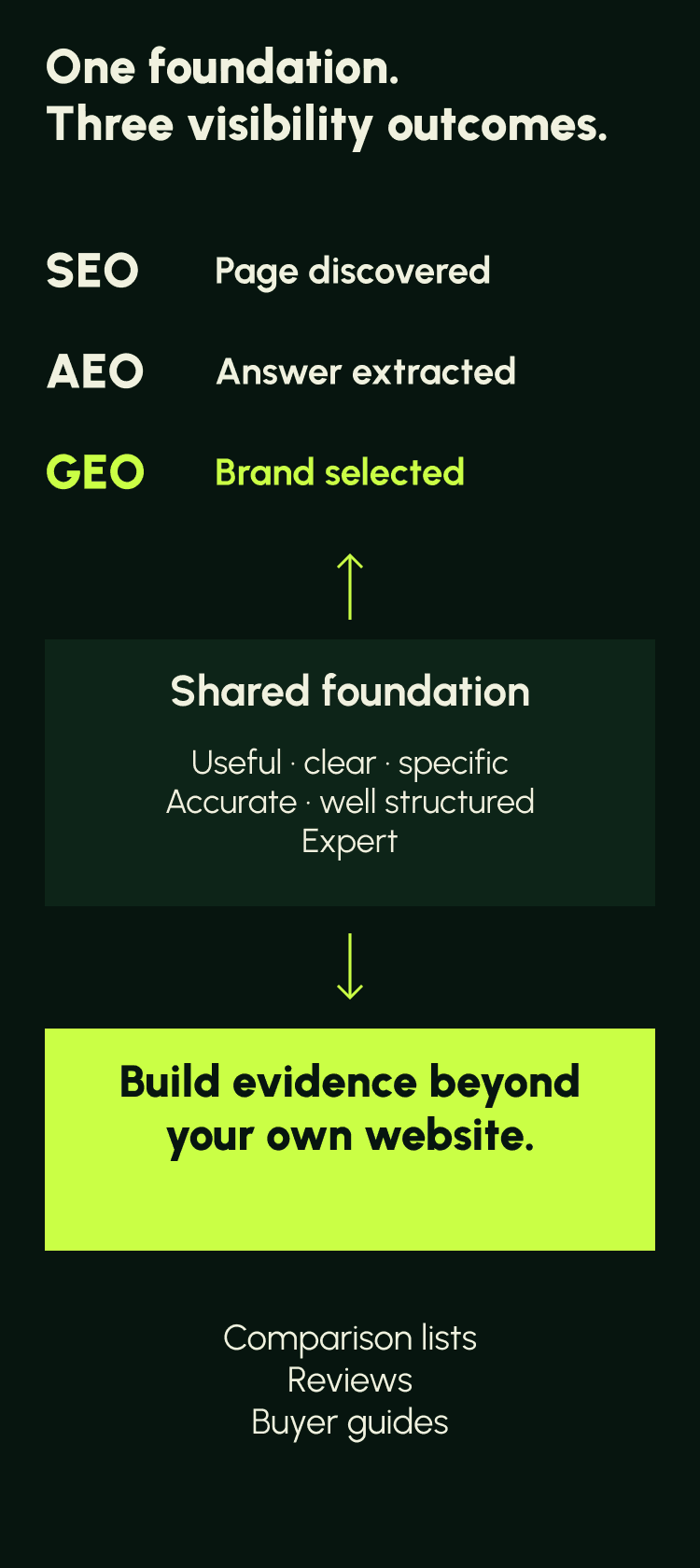
Search engine optimisation (SEO), answer engine optimisation (AEO) and generative engine optimisation (GEO) are three outcomes for the same content, not three separate jobs. SEO makes a page one of the results a person can choose. AEO makes a page easy for a system to lift as the direct answer. GEO gives an AI enough reason to name, cite or recommend a brand while it builds an answer. The mechanics overlap almost entirely. The one part that does not is that the pages deciding a recommendation are mostly pages you do not own.
What if your customer never Googles you?
That question is the reason this article exists. Discovery no longer happens in one search engine. It happens wherever people ask questions, and a growing share of those questions go to a system that answers rather than one that lists.
Picture a company that has built a B2B software product. Its ideal customer has a problem the product solves. That customer might Google it. They might ask a peer for a recommendation. Or they might ask ChatGPT, Gemini or Perplexity which software they should use. Same customer, same intent, and a completely different discovery journey depending on where the question lands.
The stakes are set before anybody clicks anything. In 6sense’s 2025 Buyer Experience Report, drawn from 4,510 B2B buyers, 95% of purchases went to a company that was on the shortlist from day one. Search used to send people to you. Increasingly it decides for them.
What do SEO, AEO and GEO look like for one business?
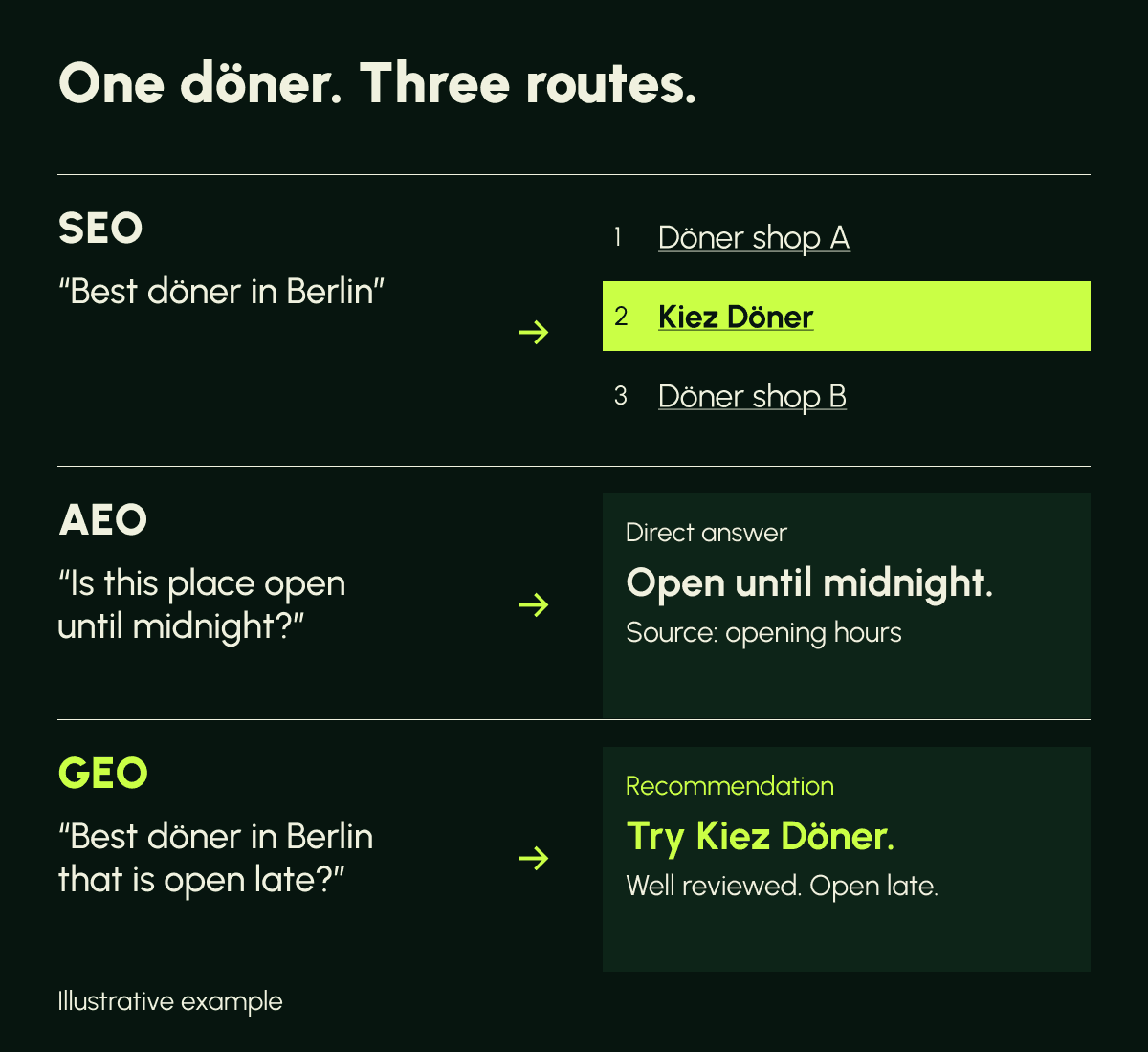
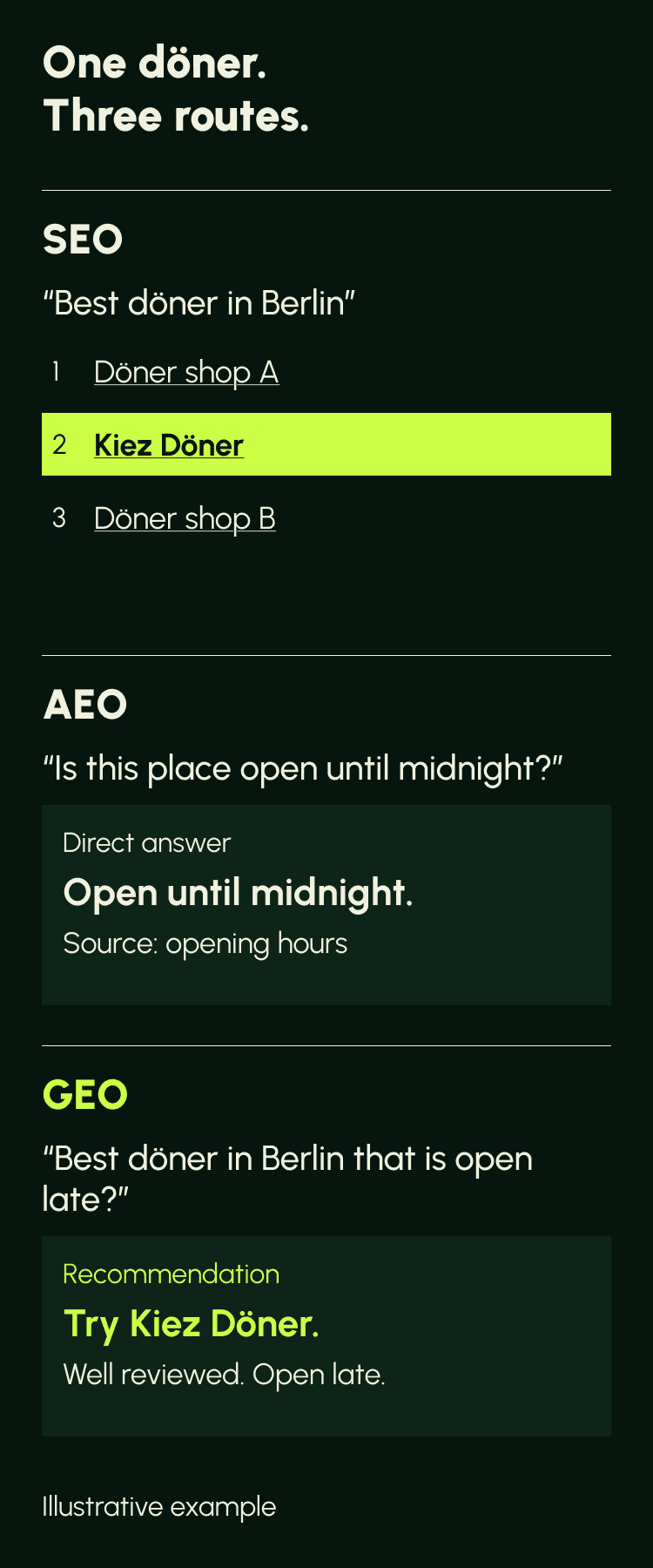
Take a döner shop in Berlin. Call it Kiez Döner; it is not a real shop, and the answers below are illustrations rather than captured screenshots. One business, three routes to it.
Someone searches "best döner in Berlin" and gets a list of links. Kiez Döner wins if one of those links is about it and the searcher chooses to click. That is SEO.
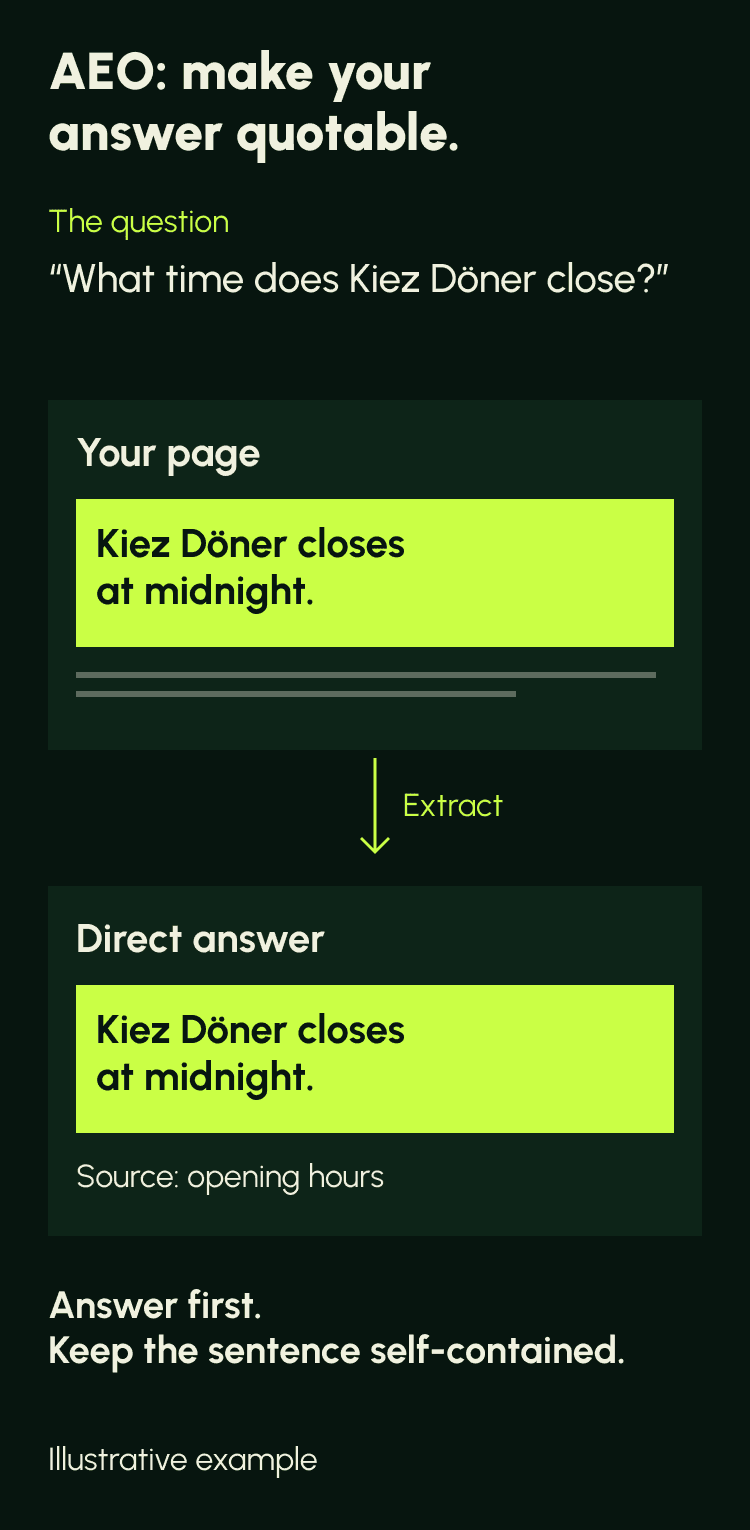
Someone asks whether the place is open until midnight and gets the answer directly, with no scrolling and no page opened. Kiez Döner wins if its opening hours are published somewhere a system can read and trust. That is AEO.
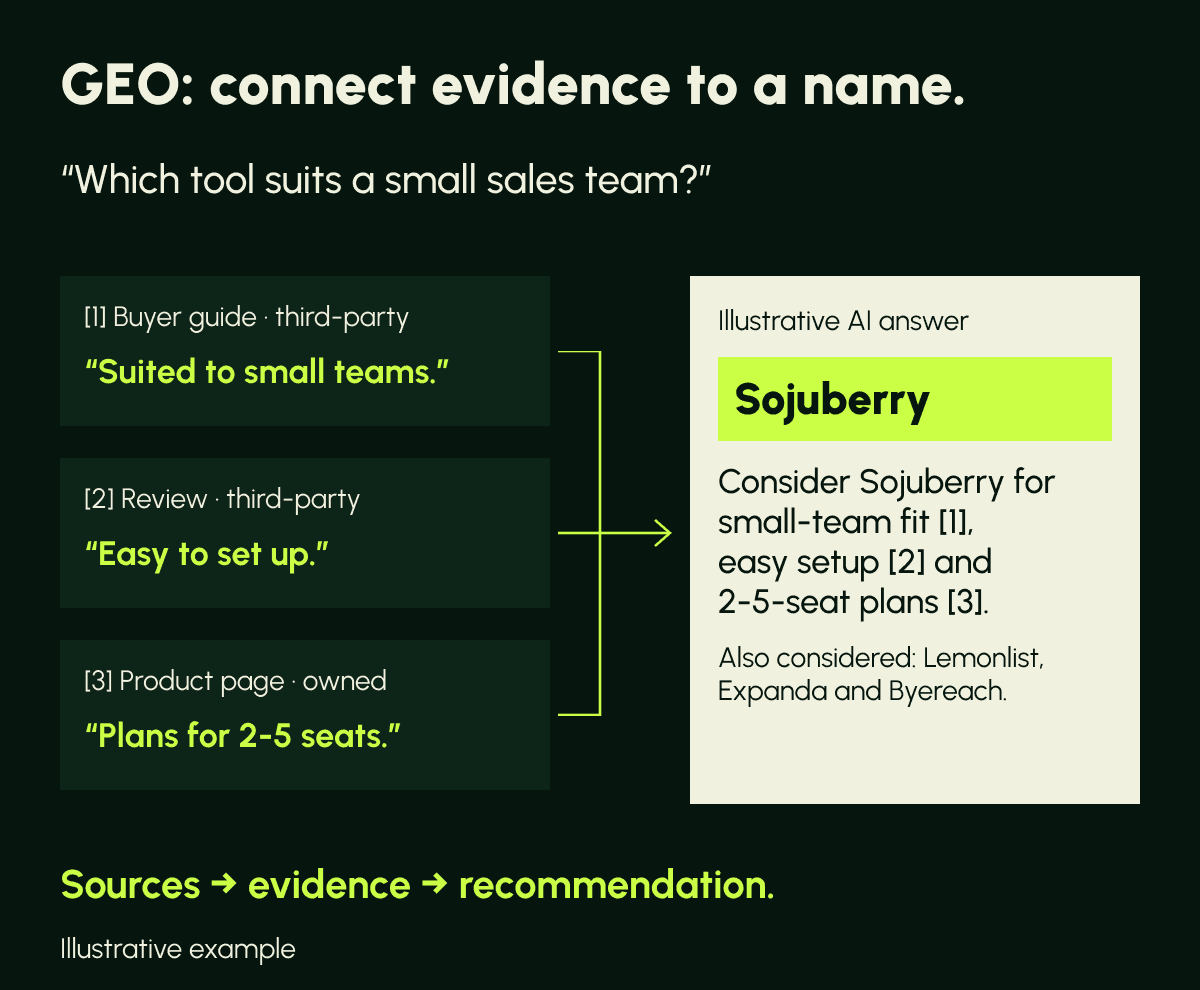
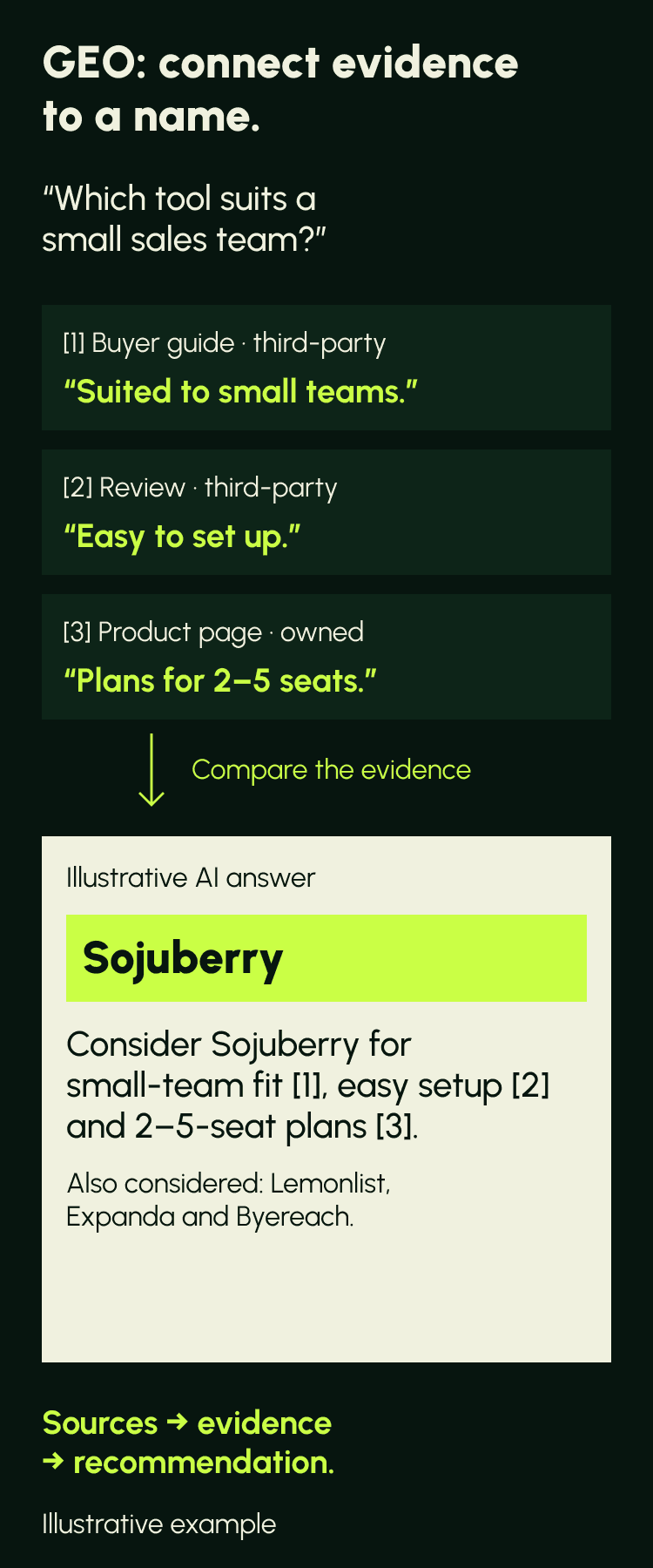
Someone asks an AI which döner in Berlin is best and open late, and the AI recommends one, with a reason. Kiez Döner wins if enough credible sources say it is good, and say so specifically enough for the AI to repeat. That is GEO.
Three routes, rewarding three different things: a page that ranks, a fact that can be lifted, and a reputation that can be cited.
What is search engine optimisation (SEO)?
Search engine optimisation is the work of earning visibility when people search: making a page one of the results a person can choose. The question it asks is how to get found when someone searches.
Someone types "best prospecting tool for LinkedIn". Google shows the pages it thinks could help. The job is to make Google conclude that your page deserves to be among them, which means helping it understand four things: what the page is about, whether it is genuinely useful, whether the site can be trusted, and whether the page is easy to reach and read.
SEO is also the floor the other two stand on, and Google says so in its own documentation for its AI features.
A page that cannot be read cannot be quoted anywhere either. Vercel’s analysis of 963 million monthly AI crawler fetches found that none of the major AI crawlers execute JavaScript. Server-rendered HTML, crawlers allowed, stable URLs. Ordinary technical SEO, and still the first job.
SEO is best for the part of the problem you own outright. When the constraint is that your own pages cannot be found or read, this is the whole answer, and no amount of work elsewhere substitutes for it.
There are no additional requirements to appear in AI Overviews or AI Mode, nor other special optimizations necessary. You don’t need to create new machine readable files, AI text files, or markup to appear in these features. There’s also no special schema.org structured data that you need to add.
What is answer engine optimisation (AEO)?
Answer engine optimisation is the work of making a page easy for a system to use as the source of a direct answer. An answer engine is any system that returns an answer rather than a list of links: Google’s AI Overviews and AI Mode, a featured snippet, Perplexity, or ChatGPT with search switched on.
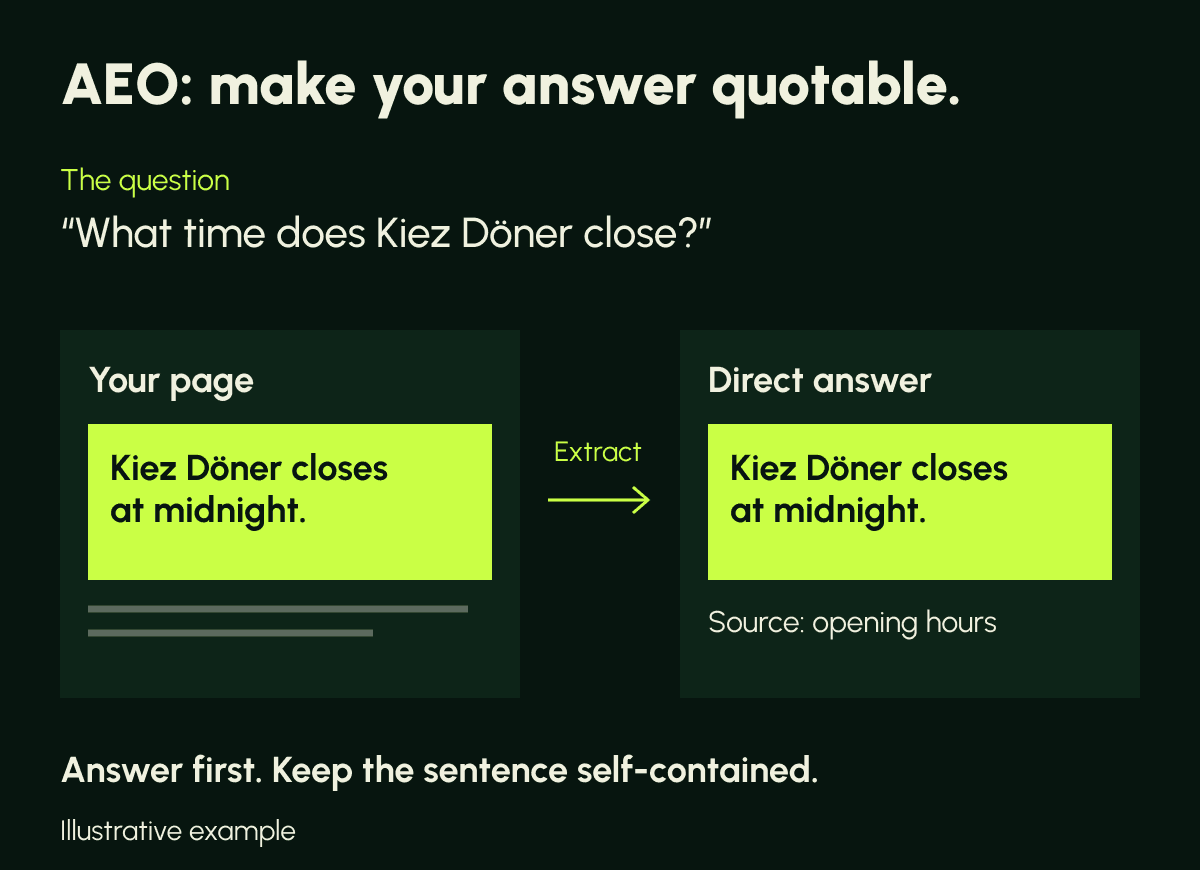
Stay with the döner shop. Somebody asks what time Kiez Döner closes. If the page says "Kiez Döner closes at midnight" in those words, the engine has a sentence it can lift whole. If the page says "we are here until late, come by after the cinema", it has nothing to quote, and the answer goes to whichever page did say it plainly.
The question shifts. It is no longer whether your page can rank. It is whether a system can use your page to answer the question. In B2B the same shift applies to "how many prospects should I contact per day on LinkedIn", or any other specific question a buyer asks before they have a vendor in mind.
Two habits make a page extractable. Open with the answer, in a sentence that still makes sense when it is quoted with the heading gone and the page gone. And cover the sub-questions rather than only the head question: Google states that AI Overviews and AI Mode may issue multiple related searches across subtopics to build a single answer, so a page that answers only the headline question misses most of what the engine goes looking for.
AEO is best for the questions a buyer asks before they have a vendor in mind. Compared to SEO it changes almost nothing technical and almost everything about how a page is written.
What is generative engine optimisation (GEO)?
Generative engine optimisation is the work of giving an AI enough reason to mention, cite or recommend a brand while it builds an answer. The term comes from a 2023 Princeton paper published at KDD 2024, which tested which changes to a page make a generative engine more likely to feature it.
Now somebody asks an AI which tool suits a small sales team. The AI does not find one website and hand it over. It has to build an answer: it compares tools, weighs features and pricing, reads what each product is said to be good at, pulls from several sources, and then decides which names are worth putting in the reply. You are no longer competing to rank. You are competing to be part of the answer.
The question GEO asks is why an AI should mention your brand while it assembles that reply. It becomes easier to answer when the brand is understood clearly, associated with the topic, backed by specific and credible information, concrete enough to be referenced, and mentioned across sources the engine already treats as trustworthy.
That last point is where GEO stops being about your own site. Ahrefs analysed 26,283 source URLs across 750 top-of-funnel prompts and found best-of blog lists were 43.8% of the page types ChatGPT cites, the largest single category. Wix’s study of 1,056,727 citations found listicles took 40.9% of citations on commercial questions, and that third-party listicles out-cited brand-owned ones 80.9% to 19.1%.
The sharpest number on this comes from Ranqo, which read 149,912 citations across 102 brands and five engines between March and May 2026. Company websites took 75.2% of those citations. The company the buyer actually asked about took 2.9%. Almost everything an engine cites when answering about you is published by somebody else, most of it by other companies in your category.
That figure is worth reading carefully, because a second large study looks like it says the opposite. Profound’s analysis of 11.84 billion citations found roughly 57% of citations go to brand-owned sites. Both are true and they count different things. Profound is asking how many citations point at any company’s own site rather than at a publisher. Ranqo is asking how many point at the one company in the question. So the web an engine reads is mostly corporate, and it is mostly not yours.
The Princeton paper is specific about the page itself too. Adding statistics, quotations and citations measurably improved visibility in generative answers. Keyword stuffing performed at or below the unoptimised baseline.
GEO is best for a company whose own pages are already good and whose name still does not come up. When to reach for it is the day a founder forwards a screenshot of an answer that names three competitors.
Through rigorous evaluation, we demonstrate that GEO can boost visibility by up to 40% in generative engine responses. Moreover, we show the efficacy of these strategies varies across domains, underscoring the need for domain-specific optimization methods.
Are AEO and GEO just SEO with new names?
Mostly yes on the mechanics, and genuinely no on one point.
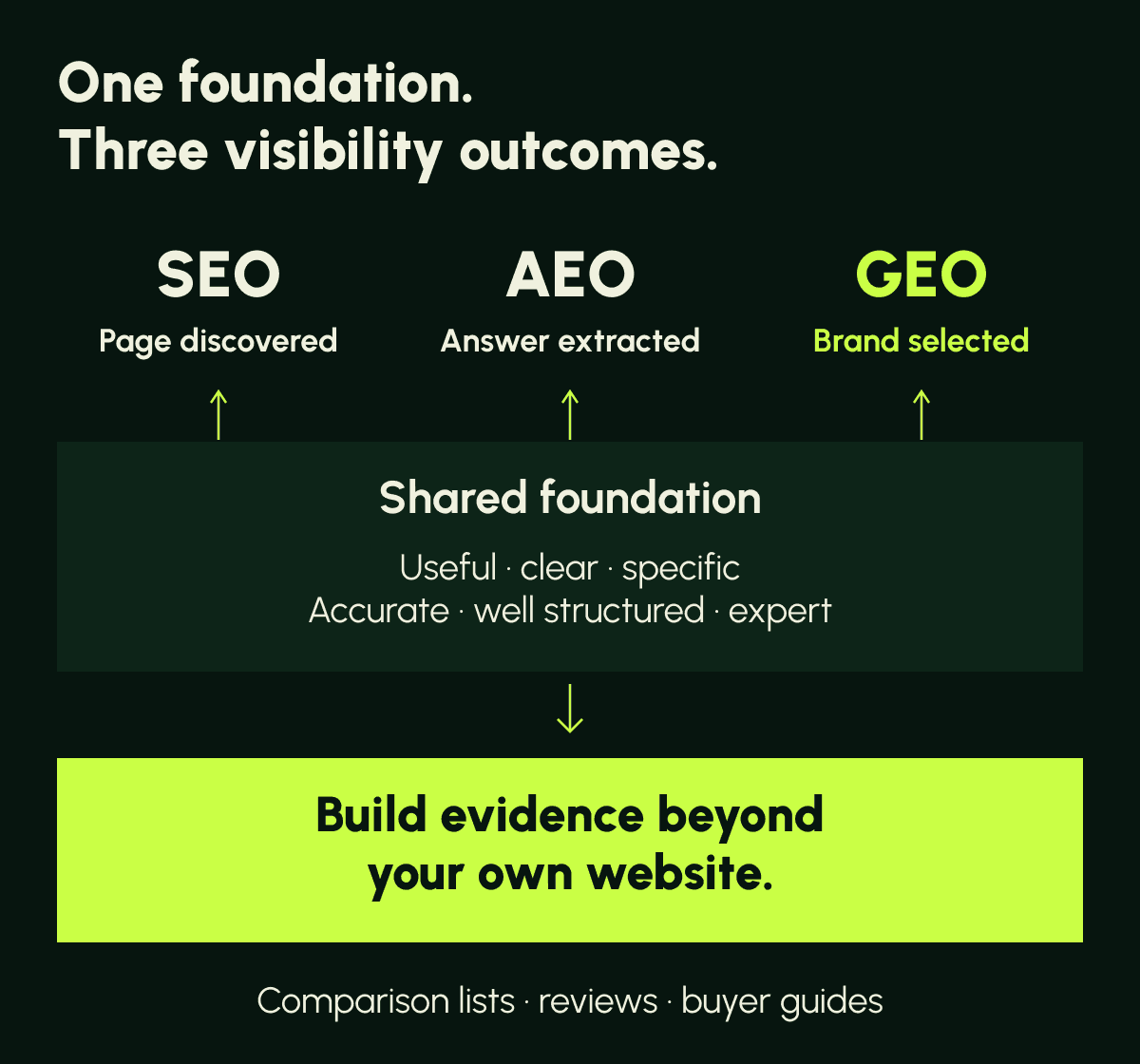
All three reward content that is useful, clear, specific, accurate, well structured and backed by real expertise. Google says the requirements for its AI features are the same as for ordinary search. Changing the acronym does not rescue thin content, and a page that would not rank will not be extracted or selected either.
The one genuine difference is where the deciding page lives. SEO and AEO are done on pages you own. GEO is mostly decided by pages you do not: the comparison article, the review platform, the analyst list. No amount of work on your own domain adds you to somebody else’s roundup. That is the part of this work that does not fit inside an SEO retainer, and the comparison of the two on this site sets out where each one is the better buy.
| Compared on | SEO | AEO | GEO |
|---|---|---|---|
| The outcome | Get discovered | Get extracted | Get selected |
| What the buyer does | Searches and picks a result | Asks a specific question | Asks for a recommendation |
| What the engine does | Lists pages that could help | Lifts one answer from one source | Builds an answer from many sources and names a few brands |
| What you optimise | Your page, to rank | Your page, to be quotable | Your reputation across pages, most of which you do not own |
| The question you ask | Can my page rank? | Can a system answer from my page? | Does my brand become part of the answer? |
| How you measure it | Rankings and sessions | Snippet and AI Overview presence | Whether, where and how the answer names you |
| Best for | Pages nobody can find or crawl | Specific questions asked before a vendor is chosen | A category whose answers name your competitors |
Which one decides a B2B software shortlist?
The mindset tends to move in stages. A beginner reads SEO as ranking first on Google. An intermediate marketer adds AEO and thinks in rankings and answers. The version worth arriving at is all three together: be useful wherever the customer asks the question.
The real question is no longer whether you can rank. It is whether your brand becomes part of the answer when somebody asks about your category.
For B2B software that question is mostly still open, and it is sticky once it closes. Semrush and Kevin Indig studied 1,094 categories in ChatGPT and found only 15.2% had a clear owner. Among owners with a meaningful lead, 90% held first place month over month.
The measure is not traffic. Conductor’s 2026 benchmark across 13,770 domains put AI referral traffic at 1.08% of total website visits. The value of being named is not the click. It is being on the shortlist before the buyer speaks to anyone.
What should you do first?
The order matters more than the vocabulary. Each step is worth little until the one before it is done, so this is a sequence rather than a menu.
Make the site readable
Server-render your pages, allow AI crawlers in robots.txt, keep URLs stable. OpenAI documents that sites blocking OAI-SearchBot will not be shown in ChatGPT search answers. This is technical SEO and it comes first.
Publish the pages that answer the sub-questions
Comparison pages, alternatives pages and a pricing page with real numbers. Company websites take the large majority of what engines cite, so these pages are what gets quoted about you when anything does. Open each one with the answer.
Get onto the third-party pages that already decide the category
Find the comparison lists, review platforms and buyer guides the engines cite for your buying questions, check whether you are on them and how you are described, and fix the ones you are missing from. This is the half no work on your own domain reaches.
Measure in answers, not sessions
Put the buying questions your customers ask to the engines they use, on a fixed cadence, and record whether you are named, where, and how accurately. Sessions will not show the change. Transcripts will.
What people ask
- What is the difference between SEO, AEO and GEO?
- SEO, or search engine optimisation, gets a page discovered as one of the results a person can choose. AEO, or answer engine optimisation, gets a page extracted as the direct answer to a specific question. GEO, or generative engine optimisation, gets a brand selected inside an answer an AI builds from many sources. The mechanics overlap almost entirely. The difference is the outcome each one targets and, for GEO, that most of the deciding pages belong to somebody else.
- What is an answer engine?
- An answer engine is a system that responds to a question with an answer rather than a list of links. Google’s AI Overviews and AI Mode, featured snippets, Perplexity, and ChatGPT with search enabled are all answer engines. Each one reads pages, lifts or summarises what they say, and shows the result to the user, usually naming the sources.
- Is GEO the same as AEO?
- No, although the two are often sold as one line on the same retainer. AEO makes a page on your own site easy to quote as the answer to one specific question. GEO makes a brand likely to be named when an AI builds a recommendation from many sources, most of them third-party pages such as comparison lists and review platforms. A company can be strong at AEO and absent from every AI recommendation in its category.
- Do I still need SEO if buyers are asking AI instead of searching?
- Yes, and it comes first. Google’s documentation for its AI features states there are no additional requirements beyond ordinary search eligibility, and no major AI crawler executes JavaScript, so a page that cannot be crawled and rendered cannot be quoted by anything. SEO is the floor. AEO and GEO are what happens on top of it.
- Which AI engines count as generative engines?
- ChatGPT, Gemini, Perplexity, Claude and Google’s AI Overviews and AI Mode are the generative engines most B2B buyers use. Each answers a buying question by reading a set of pages and composing a reply that names a few options. GetMOW measures up to six of them per engagement, chosen with the client and fixed in writing before the first run.
- Does schema markup or an llms.txt file improve GEO?
- The best available evidence says no. Ahrefs tracked 1,885 pages that added JSON-LD schema against 4,000 matched controls and found Google AI Overviews citations fell 4.6%, while the effect on AI Mode and ChatGPT was indistinguishable from zero. Ahrefs also read the server logs of 137,210 domains and found 97% of published llms.txt files received no request at all in a month. Neither is a lever.
- Whose website do AI engines actually cite when answering about a company?
- Mostly somebody else’s. Ranqo read 149,912 citations across 102 brands and five AI engines between March and May 2026 and found company websites took 75.2% of citations while the company being asked about took just 2.9%. This sits alongside Profound’s finding, from 11.84 billion citations, that roughly 57% of citations point at brand-owned sites rather than publishers. The two agree once you see that Profound counts any company’s own site and Ranqo counts only the company in the question. The web an engine reads about you is mostly corporate, and mostly not yours.
- How do I know whether AI engines name my company?
- Ask them. Put the buying questions your customers ask to ChatGPT, Gemini and Perplexity, and read the answers: whether your company is named, whether it is described correctly, and which pages are cited. Do it on a fixed set of questions on a fixed cadence, because a single answer varies from run to run. GetMOW’s free AI visibility report does this and returns the transcripts.
Who wrote this
Client Lead, GetMOW
Digvijay Rathore runs the AI visibility reports and the client engagements at GetMOW in Berlin. The questions in this article are the ones prospects ask on the first call.
Where the numbers come from
Read in September 2026
- 6sense, 2025 Buyer Experience Report
- Google Search Central, AI features and your website
- Vercel, The rise of the AI crawler
- OpenAI, Overview of OpenAI crawlers
- Aggarwal et al., GEO: Generative Engine Optimization
- Ahrefs, What AI search engines cite
- Wix Studio AI Search Lab, The content types most cited by LLMs
- Semrush and Kevin Indig, ChatGPT topic authority study
- Conductor, AEO and GEO benchmarks report
- Profound, Where do AI citations come from
- Kumar, Generative Engine Optimization at Scale (Ranqo)
- Ahrefs, We tracked 1,885 pages adding schema
- Ahrefs, 97% of llms.txt files are never read
Start with what the answers say about you.
Before you weigh any of this, see the answer ChatGPT, Gemini and Perplexity give today when a buyer asks who to consider in your category. The AI visibility report is free, written for your category, and yours whatever you do next.